
Workaholism in Dubai: Signs, Causes, and How to Break Free Without Sacrificing Success
Updated: 3 days ago
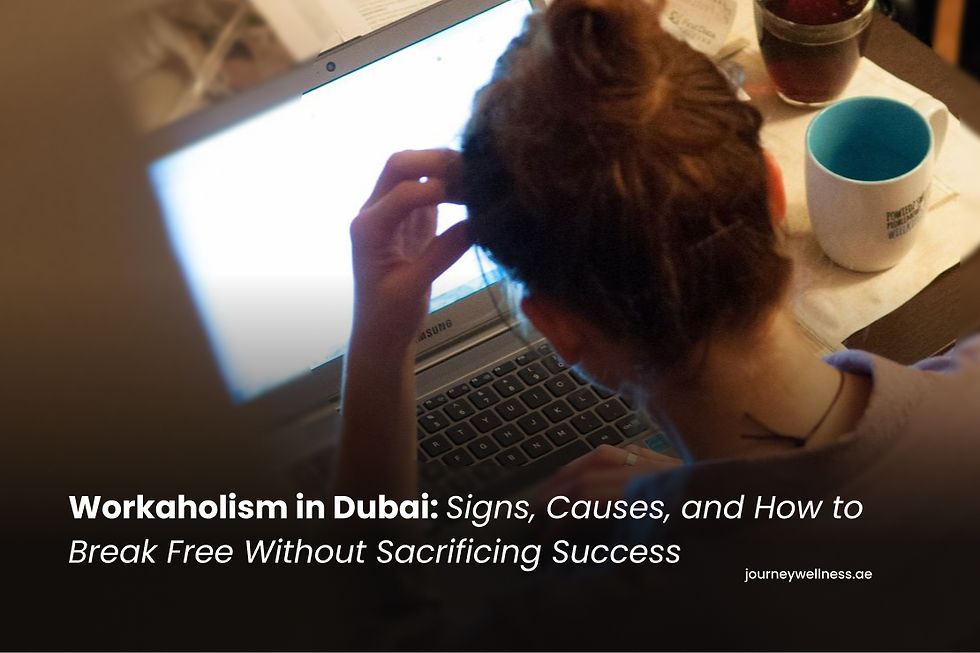
In most cultures, working extremely hard is admired. In Dubai, it can feel like a baseline expectation. Long hours, weekend availability, constant connectivity, the identity built around career achievement — these are the cultural fabric of professional life in the city. This is part of why workaholism is both exceptionally prevalent here and exceptionally difficult to identify: because it looks exactly like ambition, which is celebrated.
But workaholism is not ambition. It is a compulsive relationship with work that, like all compulsive patterns, is driven not primarily by genuine passion or external demand but by an internal psychological pressure that work temporarily relieves. And like all compulsive patterns, it has significant costs — to mental health, physical health, relationships, and ultimately to the quality of the very work it is ostensibly dedicated to.
What Is Workaholism?
Workaholism is a compulsive need to work excessively, regardless of the negative consequences. It differs from hard work or genuine career dedication in a crucial psychological respect: workaholics cannot stop working even when they want to, even when the work is no longer productive, and even when the costs — to their health, relationships, and wellbeing — are clearly evident.
Researchers have increasingly conceptualised workaholism as a behavioural addiction, similar in its psychological mechanisms to other process addictions. Like all addictions, it provides short-term relief from an uncomfortable internal state (anxiety, emptiness, inadequacy, fear of failure) at the cost of long-term harm.
Signs of Workaholism
You think about work even when you are not working — on holiday, at dinner, in bed
You feel anxious, irritable, or guilty when you are not working
You work significantly more hours than required by your role, consistently and by choice
You use work to avoid difficult thoughts, feelings, or situations outside of work
Relationships, health, and personal interests have significantly deteriorated because of work
You have been told by people you care about that work is taking too much of you
Rest feels uncomfortable or wasteful — you cannot genuinely relax without feeling guilty
Your self-worth is almost entirely tied to your professional achievement and productivity
What Drives Workaholism: The Psychology Beneath the Productivity
Anxiety Management
Work provides a reliable, socially acceptable way to manage anxiety. While working, there is a defined task, a measurable progress, a clear external focus. Stopping work means being alone with internal experience that is harder to manage. The compulsive quality of workaholism is fundamentally an anxiety-management pattern.
Contingent Self-Worth
For many workaholics, worth and identity are almost entirely contingent on achievement. Without a strong sense of inherent worth independent of productivity, stopping work feels like stopping mattering. This is particularly common in individuals who received approval primarily for achievement in childhood.
Avoidance of Personal Life
Work can be a highly effective avoidance strategy — for relationship difficulties, existential questions, grief, loneliness, or any personal territory that is too uncomfortable to sit with. In Dubai's professional culture, this avoidance is consistently socially rewarded.
The Cost of Workaholism
Contrary to the culture that glorifies it, sustained workaholism does not produce better outcomes. Research consistently shows that productivity declines significantly beyond 50 hours per week, and declines to essentially zero beyond 55. Creativity, strategic thinking, and quality decision-making all require rest to function. Workaholism is not good for the work — it just feels urgently necessary.
The personal costs are more severe: chronic stress, burnout, anxiety and depression, relationship breakdown, physical health deterioration, and the gradual erosion of everything that makes work and achievement meaningful.
Finding a Sustainable Path
Addressing workaholism requires working with the underlying psychological drivers, not simply setting work hours limits that inevitably collapse under anxiety. At Journey Wellness Centre in Dubai, our therapists and coaches work with workaholics to understand what the work is protecting them from, build genuine self-worth independent of achievement, and develop the capacity for rest, relationship, and personal life without the anxiety that currently makes these feel impossible.
Success Shouldn't Cost You Everything Else That Matters
Workaholism is treatable. Our therapists and coaches at Journey Wellness Centre in Dubai help high achievers in Dubai build a sustainable relationship with work — and themselves.

Comments